Java and C# are often described as rivals - born from similar philosophical roots, shaped by massive corporate investments, and used in largely overlapping problem spaces. Both are statically typed, object-oriented, garbage-collected, and designed for building serious software at scale. Both run on virtual machines. Both have enormous ecosystems.
And yet, they’ve evolved in meaningfully different directions. Knowing which to reach for - and why - is the mark of a developer who has thought carefully about the tools, not just learned whichever one came first.
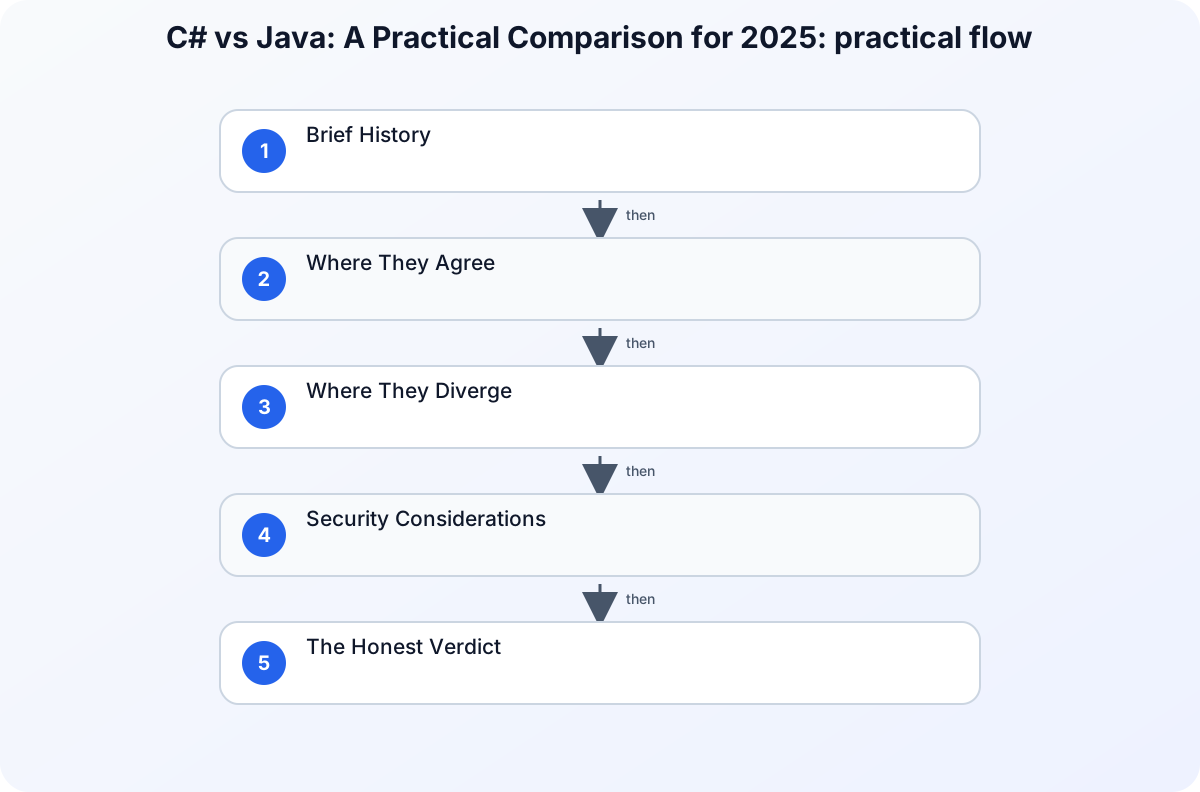
Reading path: Begin with the concept, use the code or comparison example to make it concrete, and finish with the design trade-off or practical rule.
Brief History
Java was created by Sun Microsystems in the mid-1990s around one core idea: write once, run anywhere. The JVM (Java Virtual Machine) abstracts over the underlying hardware, letting the same bytecode run on any platform that supports the JVM. Oracle acquired Sun in 2010 and now stewards the platform, though OpenJDK keeps Java open-source.
C# was Microsoft’s answer to Java, created by Anders Hejlsberg and launched in 2000 as part of the .NET Framework. Initially Windows-only, it’s since become genuinely cross-platform with .NET (now reaching .NET 9/10), running on Linux, macOS, and Windows alike.
Where They Agree
Before the differences: Java and C# share more DNA than their different ecosystems suggest.
| Concept | Explanation |
|---|---|
| Object-oriented | Both are built around classes, inheritance, and interfaces |
| Garbage collection | Both manage memory automatically via GC |
| Strong type systems | Static typing with generics in both |
| Multithreading | Both have robust concurrency primitives |
| Cross-platform | Both run on Windows, Linux, and macOS as of 2025 |
Where They Diverge
Language Features
C# has historically moved faster on language features. Properties, delegates, events, async/await, LINQ, pattern matching, record types, and nullable reference types all arrived in C# before equivalent features landed in Java.
Java has been catching up aggressively since Java 8: lambda expressions, streams, Optional, records, sealed classes, pattern matching, and virtual threads (Project Loom) have significantly modernized the language. But the reputation for verbosity lingers, partly because so much Java code in the wild was written before these improvements existed.
// C# - concise with modern features
var users = userList
    .Where(u => u.IsActive)
    .Select(u => u.Name)
    .ToList();
// Java - equivalent with streams
var users = userList.stream()
    .filter(User::isActive)
    .map(User::getName)
    .collect(Collectors.toList());
Both are readable. C#’s LINQ often wins on expressiveness in data-manipulation scenarios.
Performance
Both are high-performance managed runtimes - orders of magnitude faster than Python, competitive with each other in most real-world workloads. The JVM’s JIT compilation produces exceptional throughput for long-running services. The CLR (.NET runtime) tends to have faster startup times and can outperform the JVM in some latency-sensitive scenarios.
For the vast majority of applications, the performance difference is irrelevant. Both platforms have been used to build systems handling billions of requests.
Ecosystem and Frameworks
Java: The Spring ecosystem dominates enterprise Java - Spring Boot, Spring Security, Spring Data, Spring Cloud. Mature, battle-tested, and deeply embedded in finance, government, and large-scale backend systems. Also the runtime for Android (historically) and big-data platforms like Hadoop and Spark.
C#: The .NET ecosystem provides ASP.NET Core for web, WPF/WinUI for Windows desktop, .NET MAUI for cross-platform mobile, and Entity Framework for ORM. Azure integration is first-class. Unity uses C# for game scripting, making it dominant in game development.
Tooling
Java developers typically use IntelliJ IDEA (the gold standard), Eclipse, or VS Code with extensions. IntelliJ’s refactoring tools and code intelligence are exceptional.
C# developers use Visual Studio (Windows, feature-rich, excellent debugging) or Rider (cross-platform, JetBrains, increasingly popular). VS Code works well for smaller .NET projects.
Both ecosystems have world-class tooling. Neither has a clear advantage here - it’s mostly preference.
Platform and Use Case Alignment
| Use Case | Preferred Language | Reason |
|---|---|---|
| Enterprise backend services | Java | Spring ecosystem, JVM maturity |
| Windows desktop applications | C# | WPF, WinUI, Windows APIs |
| Game development (Unity) | C# | Unity uses C# for scripting |
| Android development | Java/Kotlin | Native Android SDK |
| Microsoft Azure cloud | C# | First-class Azure integration |
| Big data (Hadoop, Spark) | Java | Platform compatibility |
| Cross-platform mobile (.NET MAUI) | C# | MAUI targets iOS/Android/Windows |
| Financial systems | Java | Long-standing industry adoption |
Security Considerations
Both platforms have mature security ecosystems, but their contexts differ.
Spring Security (Java) is one of the most comprehensive security frameworks available - handling authentication, authorization, CSRF, CORS, OAuth2, and session management. It’s battle-tested at enterprise scale and has a well-funded security research community.
ASP.NET Core (C#) provides comparable built-in security features with strong integration into the Microsoft security model, including Azure Active Directory and Windows Authentication.
Neither language is inherently more or less secure - security depends on how you use the platform, not which one you chose.
The Honest Verdict
There is no objectively better choice between Java and C#. The right answer depends entirely on your context:
Choose Java when:
- You’re in an enterprise environment with existing Java infrastructure
- You’re building backend services that need to integrate with the JVM ecosystem
- Your team has deep Java expertise
- You need maximum portability across diverse deployment environments
Choose C# when:
- You’re building in the Microsoft ecosystem (Azure, Windows, Active Directory)
- You’re developing games with Unity
- You want the newest language features - C# has historically moved faster
- Your team is already invested in the .NET ecosystem
Both are excellent choices for serious software development. The engineers who waste time arguing about which is “better” would be better served learning both.