Java doesn’t have a great reputation for being lovable. It’s verbose. It requires a lot of ceremony. Oracle’s licensing history has left scars. And if you’ve ever tried to explain generics or checked exceptions to someone who learned Python first, you know the look you get.
And yet, I keep coming back to Java. Not out of stubbornness or habit - but because, when I’m building something that has to actually last, Java’s constraints start looking more like features.
Here’s why.
Reading path: Read this as a trade-off analysis: each section explains where Java’s constraints help and where Python remains the better tool.
| Dimension | Java’s advantage | Python’s advantage |
|---|---|---|
| Feedback | Static typing and compiler checks | Fast experimentation and concise syntax |
| Runtime profile | JVM JIT optimization for long-lived services | Excellent scripting and data workflows |
| Ecosystem highlighted here | Spring, JUnit, Mockito, and Testcontainers | NumPy, pandas, PyTorch, and scikit-learn |
| Best fit in this article | Durable, team-maintained production systems | Automation, prototyping, data science, and machine learning |
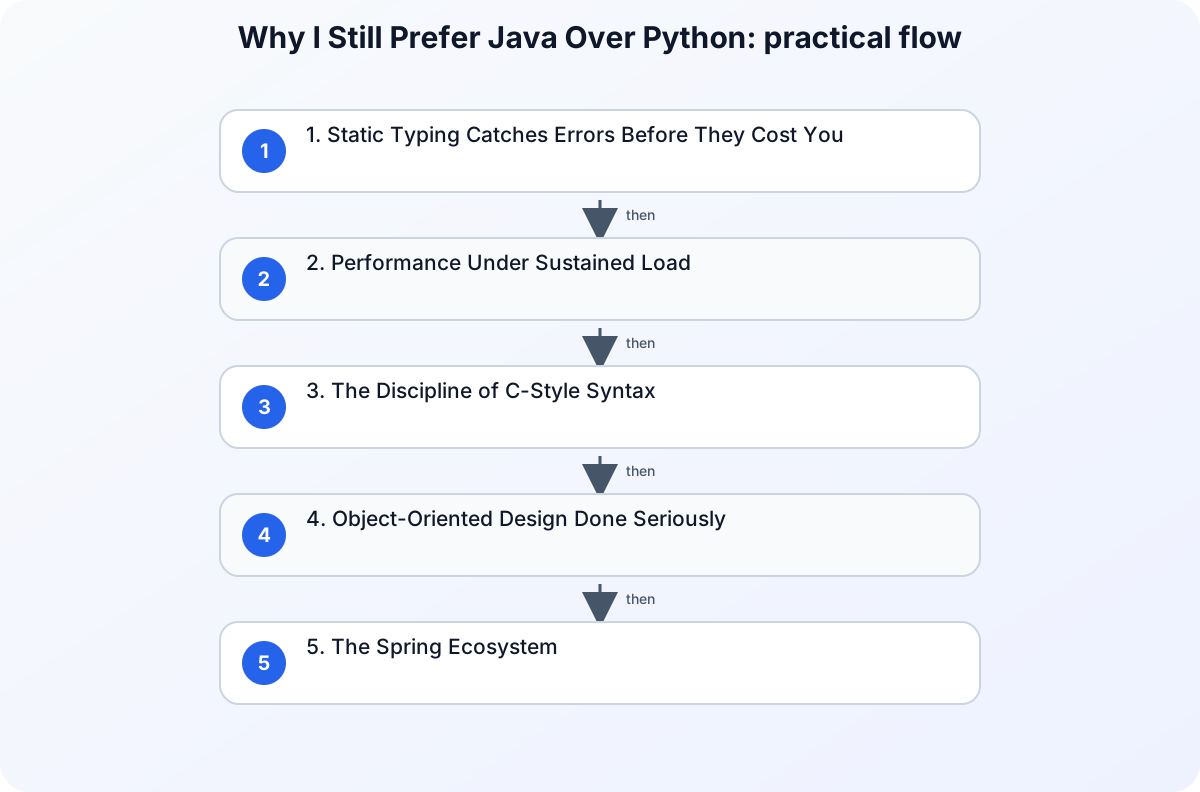
1. Static Typing Catches Errors Before They Cost You
In Python, a type error might live quietly in your codebase for months, waiting for a specific edge case to trigger it in production at 2 AM. Java eliminates entire categories of these bugs at compile time.
When you declare String name = getUserName(), the compiler knows exactly what name is. When you pass it somewhere that expects an int, it refuses to compile. The IDE underlines it immediately. This isn’t friction - it’s the code telling you something is wrong before it becomes an incident.
In large codebases with multiple developers, this matters enormously. Static typing is documentation that the compiler enforces.
2. Performance Under Sustained Load
Python is fast enough for scripts, quick data processing, and prototyping. But Java runs on the JVM, which uses JIT (Just-In-Time) compilation to optimize hot code paths at runtime. For long-running services processing millions of requests, this difference becomes tangible.
The kinds of systems where Java dominates - high-frequency trading, large-scale backend services, real-time data pipelines - tend to be exactly the systems where performance cannot be compromised. It’s not a coincidence.
3. The Discipline of C-Style Syntax
Some developers find Java’s syntax - curly braces, semicolons, explicit access modifiers, public static void main - unnecessarily verbose. I find it clarifying.
When I read Java code, I know what’s public and what’s private. I know what’s a method and what’s a field. The compiler enforces structure that Python leaves to convention. In a team environment, “convention” erodes. Structure persists.
4. Object-Oriented Design Done Seriously
Java takes OOP seriously in a way Python doesn’t require. You have to define classes, think about access control, design interfaces. This forces architectural decisions that, in Python, are easy to defer until they become expensive to fix.
For large, long-lived applications - the kind you’re maintaining years after the original author left - this structure is what makes refactoring possible without everything falling apart.
5. The Spring Ecosystem
The Spring Framework is arguably the most mature and battle-tested web application ecosystem in existence. Spring Boot, Spring Security, Spring Data, Spring Cloud - together they provide everything you need to build production-grade applications: REST APIs, microservices, security, database integration, messaging, observability.
From a security perspective, Spring Security is particularly impressive. It handles authentication, authorization, CSRF protection, session management, and OAuth2 flows out of the box - with extensive documentation and a large community. These aren’t things you want to implement yourself.
6. IDE Tooling Is Exceptional
Because Java is statically typed and structurally explicit, IDEs like IntelliJ IDEA can offer deep code intelligence: accurate autocomplete, reliable refactoring, call hierarchy analysis, find-all-usages. When you rename a method, the IDE finds every call site across millions of lines of code, with confidence.
Python IDEs do their best, but dynamic typing means they’re often guessing. At scale, “probably” isn’t good enough.
7. A Strong Testing Culture
The Java ecosystem has always taken testing seriously. JUnit, Mockito, AssertJ, Testcontainers - the tooling is mature, the patterns are well-established, and tests are a first-class artifact in most Java projects.
Testing isn’t optional in production systems. Java’s culture treats it as mandatory, which produces more reliable software.
8. Backward Compatibility
Java’s commitment to backward compatibility is extraordinary. Code written for Java 8 (2014) largely still compiles and runs on Java 21 (2023). The Java team works hard to never break existing programs - which means you’re never forced into painful migration projects just because Oracle released a new version.
Compare that to Python’s transition from 2 to 3, which took a decade and broke large amounts of existing code.
9. Write Once, Run Anywhere
The JVM is an extraordinarily portable runtime. A Java application compiled once runs on Windows, Linux, macOS, and more - without modification. For enterprise software targeting diverse infrastructure, this isn’t a nice-to-have; it’s a deployment requirement.
What About Python?
Python is excellent - genuinely. For scripting, automation, data science, machine learning, and quick prototyping, Python is often the right choice. Its ecosystem for data and AI work (NumPy, pandas, PyTorch, scikit-learn) is unmatched.
If I need to write a quick automation script, parse some logs, or experiment with a machine learning model, Python is what I reach for.
But if I’m building a service that will handle real traffic, need to be maintained by a team, has security requirements, and needs to run reliably for years - Java is where I’d start.
Equivalent typed examples
The practical difference is easier to evaluate with the same model in both languages. Java makes the immutable shape explicit with a record:
record User(String name, int loginCount) {
    boolean isActive() {
        return loginCount > 0;
    }
}

User user = new User("Eren", 3);
System.out.println(user.isActive());
Python can express the same contract with a typed dataclass, while runtime validation remains a separate design choice:
from dataclasses import dataclass


@dataclass(frozen=True)
class User:
    name: str
    login_count: int

    def is_active(self) -> bool:
        return self.login_count > 0


user = User(name="Eren", login_count=3)
print(user.is_active())
The comparison is not that one syntax automatically produces safer software. The relevant boundary is when types are checked, how invalid external data is validated, and which tooling the team consistently runs.
Final Word
Every language makes tradeoffs. Java trades brevity for clarity. It trades flexibility for safety. It trades quick-start ease for long-term maintainability.
Those aren’t tradeoffs I’m willing to make for scripts. But for serious software engineering, they’re exactly the tradeoffs I want.
Java doesn’t always offer the easiest path. It usually offers the most durable one.