Pagination is a consistency contract disguised as a performance feature. Splitting 100,000 records into pages is easy; defining what “the next page” means while records are inserted, deleted, or reordered is the real design work.
Choose a strategy from the user experience and data model:
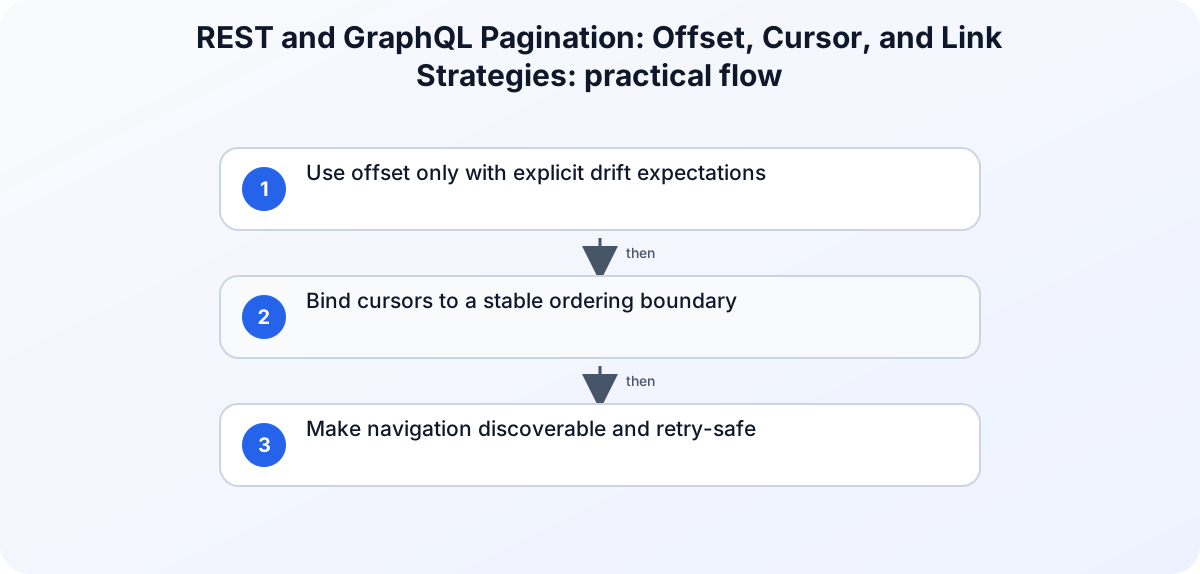
- Offset for simple, bounded, mostly stable lists and direct page numbers.
- Cursor/keyset for large or rapidly changing ordered feeds.
- Links to make navigation discoverable and decouple clients from URL construction.
- GraphQL connections when the schema should expose edges, cursors, and page metadata consistently.
Offset pagination: simple but position-dependent
GET /articles?limit=20&offset=40
SELECT id, published_at, title
FROM articles
ORDER BY published_at DESC, id DESC
LIMIT 20 OFFSET 40;
Offset is readable and supports “jump to page 7.” It has two costs:
- The database may still need to walk or discard earlier rows for deep offsets.
- Positions drift when rows change between requests.
Imagine descending IDs:
Page 1: 100 99 98
A new record 101 is inserted before the client requests OFFSET 3:
Current order: 101 100 99 98 ...
Page 2:              98 97 96
The client sees 98 twice. Deletions can make a record disappear between pages. Offset is not wrong; it simply defines pages by current positions rather than stable boundaries.
Cursor pagination: continue after a boundary
A cursor represents the last ordering position already delivered:
GET /articles?first=20&after=eyJwdWJsaXNoZWRfYXQiOiIuLi4iLCJpZCI6OTg...
For ordering (published_at DESC, id DESC), the next query uses both fields:
SELECT id, published_at, title
FROM articles
WHERE (published_at, id) < ($1, $2)
ORDER BY published_at DESC, id DESC
LIMIT 21;
Fetch limit + 1 rows. Return only limit; the extra row tells you whether has_next_page is true without a full count.
The id tie-breaker is essential. Timestamps are not guaranteed unique, so a cursor containing only published_at can skip or duplicate records with equal timestamps.
Treat cursors as opaque API tokens
Clients should store and return a cursor, not parse or modify it. A cursor payload might contain:
{
  "version": 1,
  "published_at": "2026-07-21T08:30:00Z",
  "id": 9821,
  "filter_hash": "sha256:..."
}
Encode and authenticate the payload—commonly with URL-safe base64 plus an HMAC or authenticated encryption. Base64 alone prevents neither tampering nor information disclosure.
Binding the cursor to filters and sort order avoids mistakes such as reusing a “published articles” cursor with a new query for drafts. Version the payload so the server can reject or migrate old formats deliberately.
def page_articles(*, first: int, after: str | None, status: str):
    limit = min(max(first, 1), 100)
    boundary = decode_and_verify(after, expected_filter={"status": status})

    rows = repository.fetch_after(
        status=status,
        published_at=boundary.published_at if boundary else None,
        article_id=boundary.id if boundary else None,
        limit=limit + 1,
    )

    has_next = len(rows) > limit
    page = rows[:limit]
    end_cursor = encode_cursor(page[-1], status=status) if page else None

    return {
        "items": page,
        "page_info": {
            "has_next_page": has_next,
            "end_cursor": end_cursor,
        },
    }
Validate maximum page size server-side. A cursor must not become a way to bypass authorization or inject query fragments.
What cursors do—and do not—stabilize
A keyset cursor prevents newly inserted records before the boundary from shifting later pages. It does not create a database snapshot across multiple HTTP requests.
If an already-seen record’s sort key changes so it moves beyond the boundary, it may appear again. If an unseen record moves before the boundary, it may be missed. For a fully frozen export, use a snapshot identifier, an immutable dataset version, or a server-side export job.
Document which contract you offer:
- Live traversal: reflects changes, with boundary-based continuity.
- Snapshot traversal: all pages come from one logical version.
- Best effort: duplicates or omissions are acceptable and clients should deduplicate.
REST navigation should be discoverable
RFC 8288 defines typed links between resources. A REST response can expose navigation in the Link header:
Link: </articles?first=20&after=abc>; rel="next",
      </articles?first=20&before=xyz>; rel="prev"
Or use links in the representation:
{
  "items": [],
  "links": {
    "next": "/articles?first=20&after=abc",
    "prev": null
  },
  "page_info": {
    "has_next_page": true
  }
}
Clients should follow the supplied link rather than reconstructing server URLs. That lets the server change cursor syntax or add parameters without breaking traversal.
Do not rely on parsing GitHub-style Link URLs to invent page numbers when the documentation says to use the link relations. The next URL is authoritative.
GraphQL connection design
The Relay Cursor Connections specification defines a familiar shape:
type ArticleConnection {
  edges: [ArticleEdge!]!
  pageInfo: PageInfo!
}

type ArticleEdge {
  node: Article!
  cursor: String!
}

type PageInfo {
  hasNextPage: Boolean!
  hasPreviousPage: Boolean!
  startCursor: String
  endCursor: String
}
A query requests a bounded slice:
query LatestArticles($first: Int!, $after: String) {
  articles(first: $first, after: $after) {
    edges {
      cursor
      node { id title publishedAt }
    }
    pageInfo {
      hasNextPage
      endCursor
    }
  }
}
Use edges when relationship metadata matters—for example, a member’s role in an organization. Exposing nodes as a convenience can reduce nesting, but page cursors still need a defined home.
Backward pagination (last/before) is not just forward SQL with names reversed. Implement and test ordering reversal carefully so the response remains in the documented order.
Counts, retries, and errors
Total counts
An exact totalCount may require an expensive count and can change before the next page. Return it only when the product needs it and the cost is acceptable. Alternatives include estimates, a separately cached count, or no count.
Retries
A page request should be safe to retry. The same cursor and filters should describe the same boundary, even if a live dataset produces a slightly different page after mutation. Avoid one-time cursors unless stateful traversal is an explicit contract.
Invalid cursors
Return a clear client error for malformed, tampered, expired, filter-mismatched, or unsupported-version cursors. Do not silently restart at page one; that creates duplicates that look like valid data.
Test the contract under mutation
Automated tests should:
- insert a new first record between page requests;
- delete a previously delivered record;
- create several records with the same primary sort value;
- change a record’s sort field;
- retry the same cursor;
- switch filters while reusing a cursor;
- tamper with a cursor;
- request zero, negative, and excessive page sizes;
- traverse forward and backward to the boundary.
Choose offset when its simplicity matches the experience. Choose keyset cursors when stable continuation and deep-page performance matter. In both cases, make ordering unique, navigation explicit, and mutation semantics part of the public API.