Rust ownership is not a collection of arbitrary compiler restrictions. It is a static accounting system for three questions:
- Who is responsible for a value?
- Who may access it right now?
- How long is that access valid?
If you trace those three facts instead of fighting individual error messages, moves, references, slices, and lifetimes become variations of one model.
The three ownership rules
The Rust Book summarizes the model:
- Every value has an owner.
- There can be only one owner at a time.
- When the owner leaves scope, the value is dropped.
fn main() {
    let message = String::from("hello"); // message owns the String
    println!("{message}");
} // String::drop runs here
String owns heap-allocated data. The stack variable contains metadata such as a pointer, length, and capacity; the String value is responsible for releasing its allocation.
Assignment can move a value
let first = String::from("hello");
let second = first;

// println!("{first}"); // error: value borrowed after move
println!("{second}");
Copying the small stack metadata while allowing both variables to free the same allocation would be unsafe. Rust instead treats the assignment as a move: second becomes the owner and first is no longer usable.
This differs for types implementing Copy:
let first = 7;
let second = first;
println!("{first} {second}");
Integers are copied because duplicating their bits produces two independent valid values. You can request a deep duplication of a String explicitly:
let first = String::from("hello");
let second = first.clone();
Use clone() when you truly need another owned value, not as a reflex to silence the borrow checker.
Functions make ownership visible
fn length_owned(text: String) -> usize {
    text.len()
} // text is dropped

fn main() {
    let name = String::from("Ada");
    let size = length_owned(name);
    // name is no longer available
}
If the function only needs to inspect the string, taking ownership is unnecessarily strong. Borrow it:
fn length(text: &str) -> usize {
    text.len()
}

fn main() {
    let name = String::from("Ada");
    let size = length(&name);
    println!("{name}: {size}");
}
&str also accepts string literals and slices of a String, making the API more flexible than &String.
Borrowing: access without ownership
A reference temporarily grants access while the original owner remains responsible for the value.
Rust’s central borrowing rule is:
At a given time, you may have either many shared references or one mutable reference to a value.
Shared borrows can coexist:
let text = String::from("read me");
let left = &text;
let right = &text;
println!("{left} / {right}");
A mutable borrow needs exclusive access:
let mut text = String::from("hello");
let edit = &mut text;
edit.push_str(", Rust");
println!("{edit}");
Exclusivity prevents a reader from observing a collection while another reference reallocates or mutates it.
let mut values = vec![10, 20, 30];
let first = &values[0];
// values.push(40); // could reallocate, invalidating first
println!("{first}");
The compiler rejects the mutation while first is still used. The rule prevents a real dangling-reference bug.
Borrows end at their last use
Modern Rust uses non-lexical lifetime analysis, so a borrow can end before the closing brace:
let mut text = String::from("hello");

let shared = &text;
println!("{shared}"); // last use of shared

let exclusive = &mut text; // valid
exclusive.push('!');
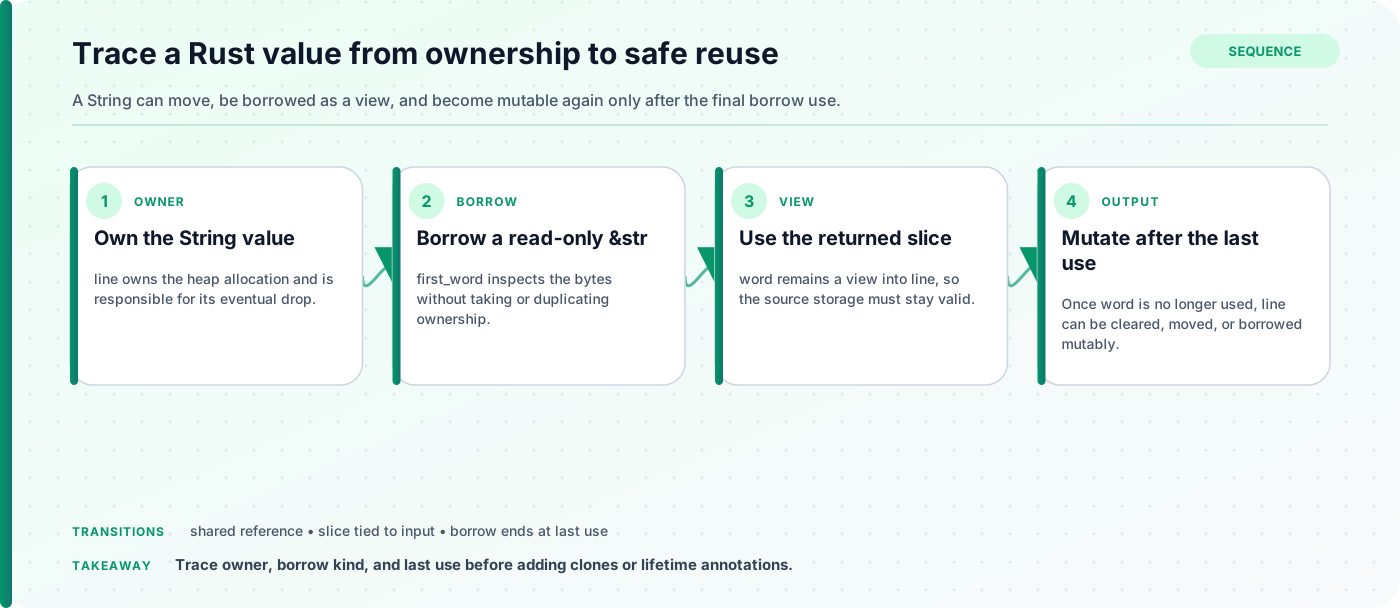
When a compiler error says a mutable and immutable borrow overlap, mark the last use of each reference. The issue is often narrower than the entire visual scope.
Slices are borrowed views
A slice describes part of a collection without owning it:
fn first_word(text: &str) -> &str {
    for (index, byte) in text.bytes().enumerate() {
        if byte == b' ' {
            return &text[..index];
        }
    }
    text
}

fn main() {
    let sentence = String::from("ownership made visible");
    let word = first_word(&sentence);
    println!("{word}");
}
The returned &str is tied to the input borrow. Rust will not allow sentence to be dropped or mutably changed while word is later used.
This function searches for the ASCII space byte, so each returned boundary is valid UTF-8: ASCII space is one byte and cannot appear inside another UTF-8 code point. A production tokenizer still needs a deliberate definition of whitespace and words.
Lifetimes describe relationships
Most lifetimes are inferred. An annotation does not extend how long data lives; it tells the compiler how reference lifetimes relate.
fn longer<'a>(left: &'a str, right: &'a str) -> &'a str {
    if left.len() >= right.len() { left } else { right }
}
The return value cannot outlive the shorter usable input lifetime because it may refer to either argument.
This is invalid:
fn dangling() -> &str {
    let temporary = String::from("gone");
    &temporary
} // temporary is dropped here
There is no truthful lifetime annotation that can fix it. Return an owned String, or borrow data owned outside the function.
A useful API decision table
| Parameter/return type | Meaning |
|---|---|
T |
Transfer or create ownership |
&T |
Read a borrowed value |
&mut T |
Mutate with exclusive borrowed access |
String |
Owned growable UTF-8 string |
&str |
Borrowed string view |
Vec<T> |
Owned growable sequence |
&[T] |
Borrowed sequence view |
Prefer the weakest capability that satisfies the function. A parser that only reads input should usually accept &str, not String; a builder returning independent data should usually return an owned value.
Read borrow-checker errors systematically
When code fails:
- Identify the value and its current owner.
- Mark every move.
- Mark shared and mutable borrows.
- Find the last use of each borrow.
- Ask whether the function really needs ownership or mutation.
- Change the data flow before reaching for
clone().
Common design fixes include:
- borrow instead of taking ownership;
- return ownership when a caller still needs the value;
- shorten a reference’s useful scope;
- split a struct into independently borrowable fields;
- compute a result before taking a mutable borrow;
- return owned data when it must outlive the input.
A compact worked refactor
This version consumes its input:
fn normalize(mut name: String) -> String {
    name.make_ascii_lowercase();
    name
}
That is excellent when transfer is intended. If the caller must retain the original, choose a different contract:
fn normalized(name: &str) -> String {
    name.to_ascii_lowercase()
}
The second function borrows the input and returns new owned output. Neither is universally better; ownership makes the cost and responsibility explicit at the call site.
Ownership is Rust’s vocabulary for resource lifetime. Borrowing is temporary access. Lifetimes are the compiler’s proof that references cannot outlive their data. Once you track those relationships, many “borrow checker problems” reveal themselves as ordinary data-flow decisions.