Heartbleed was frightening because the underlying bug was small, but the memory it exposed could contain credentials, session tokens, and cryptographic material. This article follows the flaw from the malformed heartbeat request to the operational work required after patching it.
Reading path: Start with the core security model, connect it to the real-world scenario, and finish with the controls or checklist that make the idea actionable.
| At a glance | Detail |
|---|---|
| Vulnerability class | Buffer over-read in OpenSSL’s TLS Heartbeat handling |
| Maximum leak per request | Up to 64 KB of adjacent server memory |
| Initial CVSS score discussed here | 5.0 |
| Immediate remediation | Upgrade to OpenSSL 1.0.1g or newer, then rotate exposed credentials and certificates |
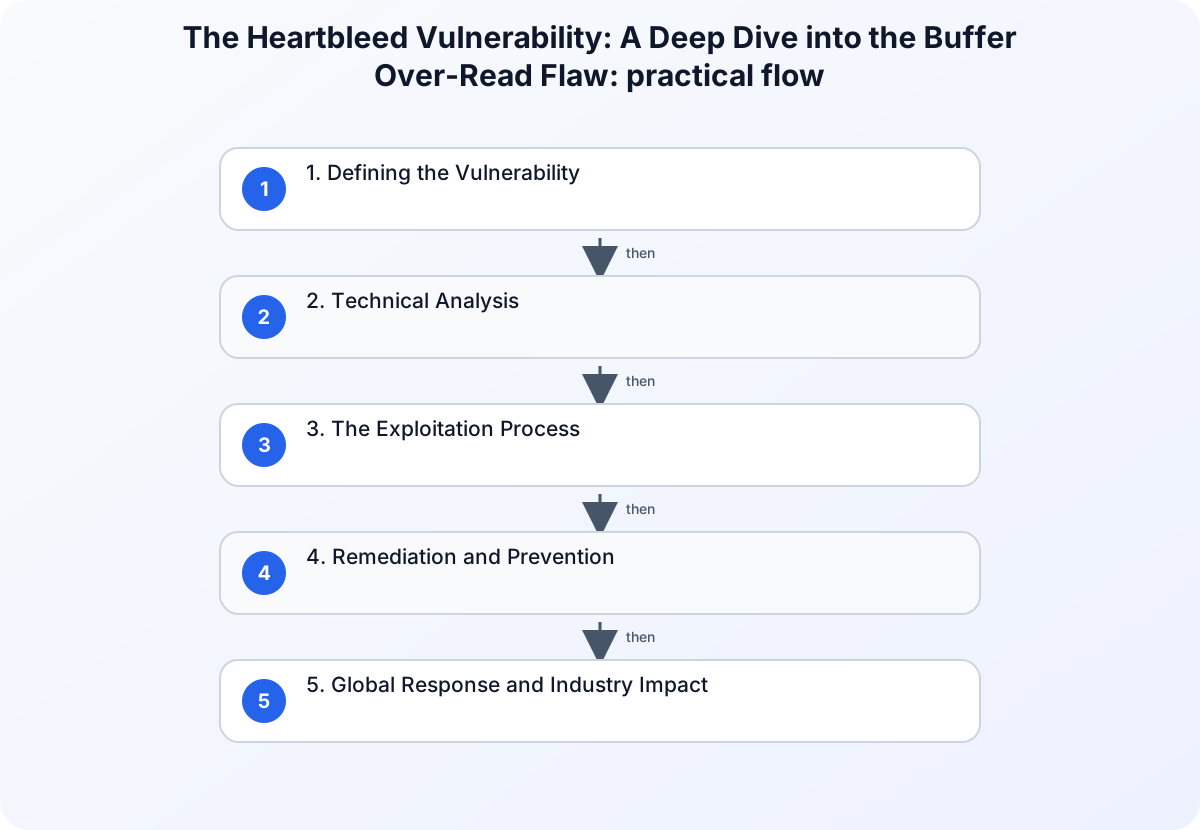
1. Defining the Vulnerability
1.1. Name and Type
Heartbleed is a critical flaw classified in cybersecurity literature as a Buffer Over-Read vulnerability. It stems from how OpenSSL handles the TLS Heartbeat extension (RFC 6520). The core issue is remarkably simple: the server never verifies the payload length declared by the client against the actual size of the transmitted data.
In the C source code, this uint16_t length parameter is passed directly to the memcpy function as an input. Consequently, if an attacker sends just 1 byte of data but claims, “I sent 65,535 bytes,” the server unquestioningly reads a 64 KB chunk from its own memory and transmits it back to the client.
1.2. Affected Systems
The scope of affected systems was extraordinarily broad: Apache and Nginx-based web servers, email services, VPN appliances, and numerous other infrastructure components were compromised. Initial measurements revealed that nearly half of the internet’s most visited web services were vulnerable. The Canadian Revenue Agency’s announcement of a data breach via Heartbleed further highlighted that this incident didn’t just affect individual users-it directly threatened critical government institutions.
2. Technical Analysis
2.1. How it Works Under the Hood
The Heartbeat mechanism is essentially an echo protocol: the client sends a payload and its length, and the server returns the exact same payload. However, in vulnerable versions of OpenSSL, the server skips bounds checking and input validation. It trusts the client’s length value blindly and feeds it to memcpy.
Because it reads beyond the bounds of the provided data, the server ends up returning whatever is currently sitting in adjacent RAM as if it belonged to the client. This scenario is a textbook example of why secure coding principles are not merely theoretical concepts.
2.2. System-Wide Impact
It is impossible to predict exactly what will be inside the leaked 64 KB memory block; it depends entirely on the server’s memory state at the exact moment of the request. However, technical analyses confirmed that these random memory chunks often contained:
- Plaintext user passwords
- Active session tokens
- The server’s SSL Private Key
If the Private Key is compromised, an attacker can effortlessly decrypt all past and future encrypted communications.
The most disturbing aspect of Heartbleed is that the breach leaves absolutely no trace in the server logs. Data is stolen silently, making detection practically impossible.
2.3. Evaluating the Risk Level
The medium-severity score (5.0) initially assigned by NIST drastically failed to convey the real-world danger. Heartbleed effectively gave attackers a transparent window into the server’s memory. Because theoretical CVSS scoring tables failed to reflect this functional devastation, the incident sparked a massive industry debate regarding the limitations of standard vulnerability scoring systems.
3. The Exploitation Process
3.1. Methodology
The exploitation process involves sending consecutive, malformed heartbeat requests to the server. In these packets, the actual payload size is tiny, but the declared payload length is huge (e.g., 1 byte of data declared as 64 KB).
Every successful request forces the server to leak a random 64 KB chunk of memory. By repeating this process thousands of times, an attacker can piece together almost the entire server memory like a jigsaw puzzle-a technique known as memory mapping. Analyzing this raw data yields critical assets:
| Concept | Explanation |
|---|---|
| Session Tokens | Capturing these allows the attacker to hijack active sessions and log into accounts without needing passwords. |
| User Credentials | Because credentials frequently pass through memory in plaintext, they are easily harvested. |
| SSL Private Keys | This is the ultimate prize. Once a server’s Private Key is leaked, attackers can even retroactively decrypt historically captured traffic. |
3.2. Tools of the Trade
Within days of Heartbleed’s public disclosure, a plethora of testing tools became available. Short Python scripts on GitHub and Nmap’s ssl-heartbleed NSE script were widely used. These tools operate on a simple premise: send one malformed heartbeat request and check if the server returns more data than provided. If the response is verbose, the server is vulnerable.
3.3. A Real-World Scenario
Consider a banking environment: An attacker continuously spams the target bank’s server with malformed heartbeat requests. Initially, the returned data might look like gibberish. But as memory mapping progresses, a session token or the bank’s SSL Private Key emerges from the noise. With the Private Key in hand, the attacker can silently monitor all communication between the bank and its customers, entirely undetected.
4. Remediation and Prevention
4.1. Patching the Flaw
The immediate fix requires upgrading OpenSSL to version 1.0.1g or newer. This patch enforces strict length validation within the Heartbeat extension, stopping malformed requests from triggering the over-read.
However, updating the library is only half the battle. Because there is no way to know if the Private Key was stolen before the patch was applied, it must be assumed compromised. Organizations had to:
- Revoke and reissue affected SSL certificates.
- Reset all active session tokens.
- Force mandatory password resets for users.
4.2. Long-Term Security Posture
Heartbleed served as a brutal reminder that open-source dependencies require continuous auditing. While patching is crucial, it is a reactive measure. Proactive security requires:
- Continuous network traffic monitoring.
- Regularly updating cryptographic protocols.
- Conducting independent code reviews.
Cybersecurity is not a one-time intervention but a continuous lifecycle of assessment, mitigation, and monitoring.
Safe OpenSSL evidence collection
Do not test Heartbleed by sending malformed heartbeat requests to systems you do not own. Start by recording the local OpenSSL build and performing a normal TLS handshake against an authorized test endpoint:
TLS_HOST='example.com'
TLS_PORT='443'

openssl version -a
openssl s_client \
  -connect "${TLS_HOST}:${TLS_PORT}" \
  -servername "$TLS_HOST" \
  -tls1_2 </dev/null
The handshake output identifies the negotiated connection and certificate but does not prove whether the server was historically vulnerable. Confirm CVE status through the deployed package version, vendor advisory, patch inventory, and—only with written authorization—a reputable vulnerability scanner.
5. Global Response and Industry Impact
The disclosure of Heartbleed triggered a remediation frenzy unprecedented in internet history. While distributing the OpenSSL update to millions of servers was fast, revoking and regenerating millions of potentially compromised SSL certificates was a logistical nightmare.
The incident proved how a “medium-level” vulnerability could cause catastrophic real-world damage. But perhaps its most enduring legacy was exposing a systemic industry failure: core internet infrastructure projects like OpenSSL were operating on shoestring budgets with severely inadequate technical support.
This realization catalyzed the creation of organizations like the Core Infrastructure Initiative (CII), designed specifically to provide regular financial and technical backing to the critical open-source projects that keep the internet running securely.